Repairing Your Own Clocks
By Mervyn Passmore

© Copyright
Mervyn Passmore 2005

M&P Home


Copyright notice
Contents
    Introduction
    Which clock to begin on?
    Hand Removal
        Pin and Collet
        Hand nut
        Friction fitting
    Removing the dial
    Letting down mainsprings
    To strip or not to strip?
        Cleaning without stripping down
    Stripping down the movement
    Repairs
        Pivots
        Bushing:
            Choosing cutting broaches
        Re-facing the pallets
        Checking the crutch and yoke
        The Platform Escapement
            Ordering a replacement platform
            Fitting a new platform
        Broken and Missing Pieces
            Broken teeth
            Suspensions.
            Clock chain
            Clock glass
            Mainsprings
            Pendulums
            Gong rods
            Winding keys
    Cleaning the dismantled movement
        Pegging out
        Using an ultrasonic tank
    Lacquering
    Re-assembly
    Lubrication
    Re-assembling and Setting up
    Setting up
        Siting
        Regulation
    Tips, Hints & Helps
        Bluing
        Silver soldering
        Soft soldering
        Dial Silvering
        Splicing 30 hour rope
        Black Marble or slate cases
    Tables
        Broach table
        Train count table

Home


Valid HTML 4.01 Transitional

Pivots

Examine each pivot in turn with the help of an eyeglass for signs of wear. Pivots should have highly polished parallel sides. If no lathe is available, one method of re-furbishing is to lightly fit a pinvice to the other end and rest the pivot to be polished on a block of wood with a groove cut in it. The pinvice is rotated while a pivot file is rubbed over the pivot. Once an even finish has been obtained, a burnisher is applied in the same manner to bring it up to a mirror finish. A new burnisher is often difficult at first and improves with a cross grain applied using medium grain emery paper. Place the emery on a flat surface and pass the burnisher over it a couple of times.
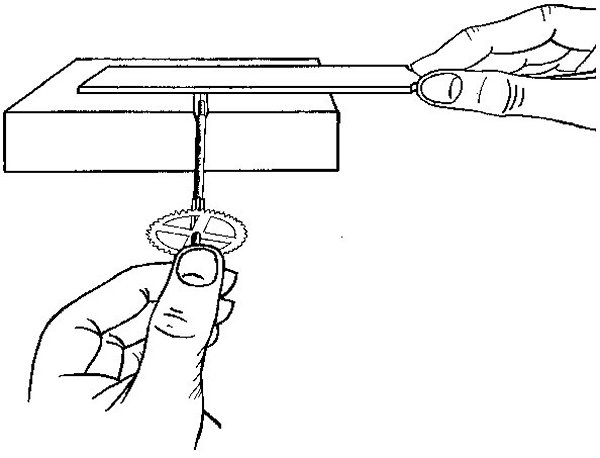
Polishing pivots with a pivot file
Polishing a pivot with a pivot file.

Repairing broken pivots normally needs the use of a lathe but pivot caps can be obtained.

Pivot caps
A pivot cap, used to repair a broken pivot if a lathe is not available.

These fit over the arbor and have ready made pivots of varying sizes. They are normally only sold in assortments of popular sizes. They are generally not fine enough for French clocks. For re-pivoting consult your material dealer or local repairer who may undertake part jobs if you don't have a lathe.


This document is © copyright M&P 2005
© Copyright Meadows & Passmore Ltd and Mervyn Passmore 2005
L10 Hit Counter - Free Web Counters
LevelTen Web Design Company - Professional Flash & Website Designers